
In this article
The first time I tried to find beginner routes like a casual 5.7 at Joshua Tree, I spent three hours hiking in circles through identical boulder piles, only to end up staring up a terrifying, unprotected slab with no chalk, no anchors in sight, and the sun setting fast. After twenty years of dialing in my safety systems on big walls and teaching climbers the ropes, I’ve seen that scenario play out more times than I can count. Taking your skills from the gym to crag and finding safe outdoor rock climbing routes requires cross-referencing messy digital data with actual physical reality, pushing past the sanitized assumptions of indoor climbing. Here is exactly how to execute that transition with confidence, relying on hard facts and field-tested strategies rather than luck.
⚡ Quick Answer: Identifying safe outdoor climbs requires far more than finding a low numerical grade on an app. You must actively filter digital databases for established sport or top-rope environments, verify the rock texture through community comments, and accurately match two-dimensional guidebook drawings to the actual three-dimensional cliff face. Establishing absolute safety means understanding massive regional grade subjectivity, building redundant equipment systems, and scrutinizing your belay platform before you tie your knot.
The Reality of the Transition: Why “Gym Strong” Isn’t Enough
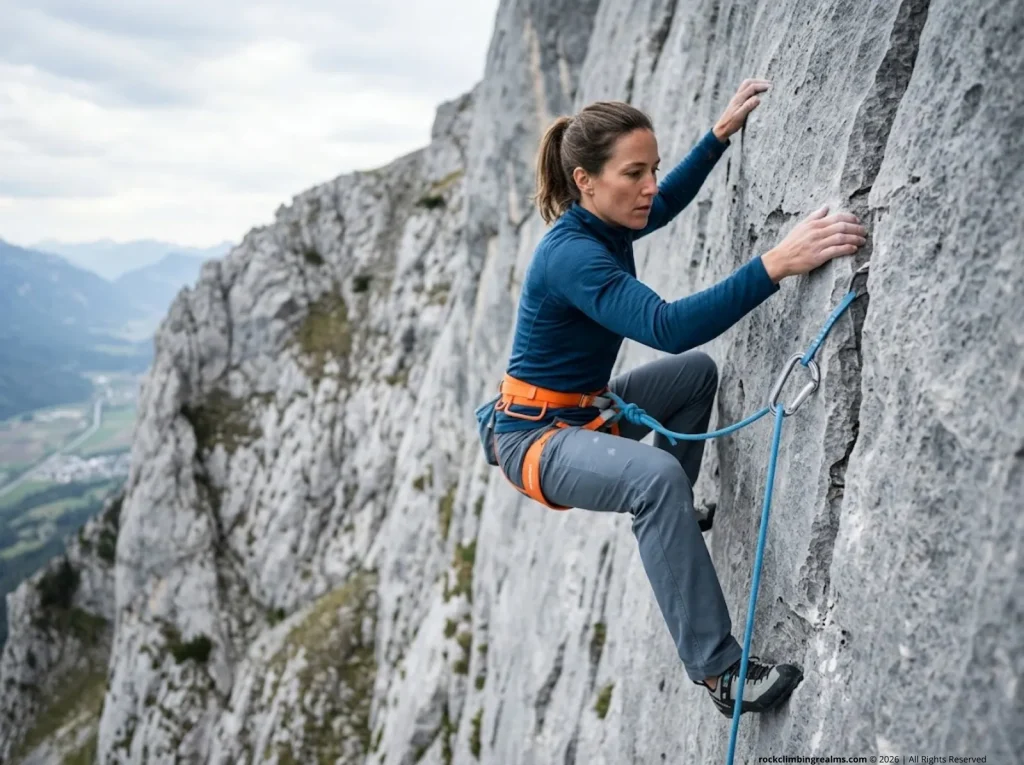
A harsh reality dictates the move from plastic holds to actual stone: gym strength creates a false sense of security. New climbers step outside possessing the physical tension needed for severe overhangs but entirely lack the logistical awareness that keeps them secure on natural terrain. To survive the transition, you must face the hard facts regarding how and why climbers get hurt.
Looking at ten years of emergency room data, we see a brutal truth. Over 26 percent of severe climbing injuries result in fractures, heavily concentrated in the legs and feet. The hospitalization rate for climbers is nearly four times higher than the average for other recreational sports. The reasons behind severe climbing injuries rarely involve finger tendon issues; they involve violent ground impact.
The twenty-foot height mark acts as a critical fracture threshold. A fall exceeding six meters massively increases the impact forces acting on your lower extremities compared to a controlled gym drop onto giant foam pads. Modern indoor facilities top out around fifty feet with absolutely zero natural ledges to hit during a fall. Outdoor cliffs possess sharp, angled ledges directly in the fall path, demanding severe belayer vigilance during top-roping or lead falls.
We see this hazard multiply when transitioning boulderers attempt their first entry-level sport lines. They often wear drastically down-sized bouldering shoes, which contort the foot and exacerbate skeletal damage during an awkward, uneven outdoor ground fall. These climbers also routinely lack vital lead-clipping intuition, creating Z-clipping or back-clipping risks that pull the rope out of the carabiner during a drop. Building accurate crag readiness means studying these safety protocols before you touch the rock.
Pro tip: Treat your first outdoor day as a gear-checking and route-finding drill, not an absolute physical performance test. Never step off the ground until your entire safety system is completely checked.
Decoding the Sandbag: How to Read Between the Lines of Climbing Grades
Relying entirely on the Yosemite Decimal System (YDS) as a universal standard is hazardous. The YDS was not engineered for modern bolted climbing faces. The Class 5 rating historically indicated any steep terrain that simply requires a rope to survive. You must recognize that absolute grade consistency across the country does not exist.
The historical context of a route grade dictates its physical hazard. A 5.8 route established in 1980 by pioneers in heavy mountaineering boots feels mechanically harder and significantly more perilous than a 5.8 established last year. Modern indoor facilities engage in softer modern grading, creating a terrifying contrast when a novice encounters “stiff” historical climbs on raw rock.
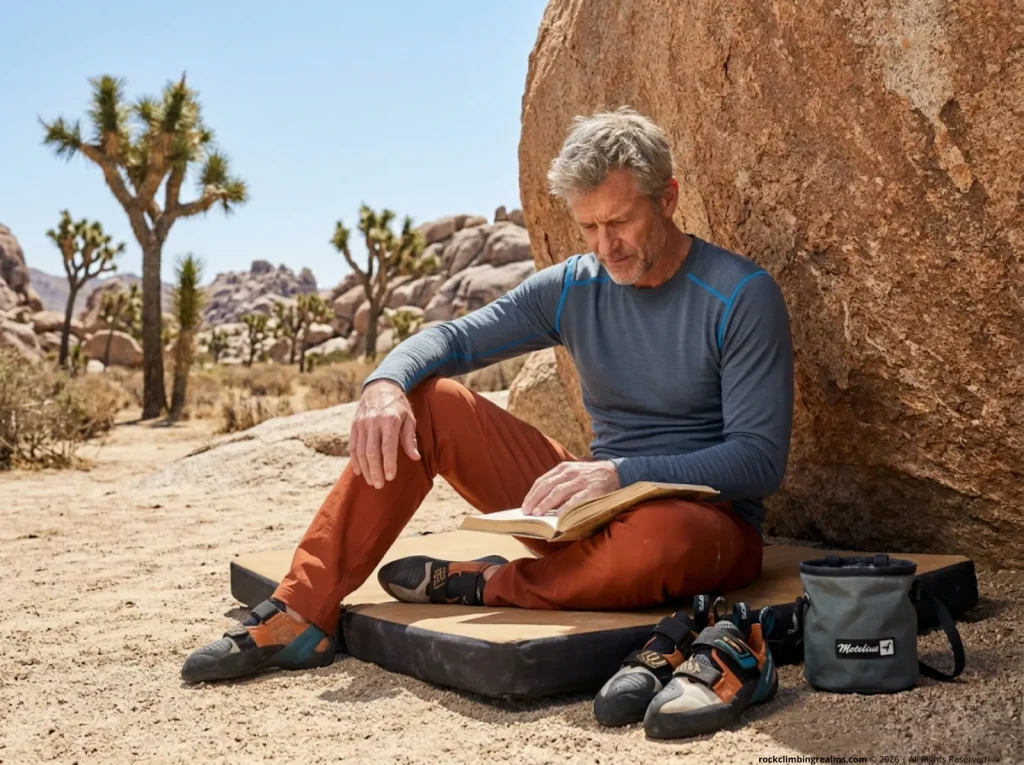
If you want to survive, you need understanding how the Yosemite Decimal System scale varies across different regions and grading systems. A popular spot like Red Rock Canyon provides “holiday grades,” where the movement generally feels forgiving. Conversely, a notorious area like Joshua Tree remains heavily sandbagged, meaning less than fifteen percent of climbers actually exceed the 5.9 level there because the rock demands supreme footwork and psychological composure. Always subtract at least two full letter grades or numbers from your absolute gym maximum when visiting new crags, acknowledging that the location might be incredibly stiff for the grade.
Digital Reconnaissance: Filtering the Noise on Mountain Project
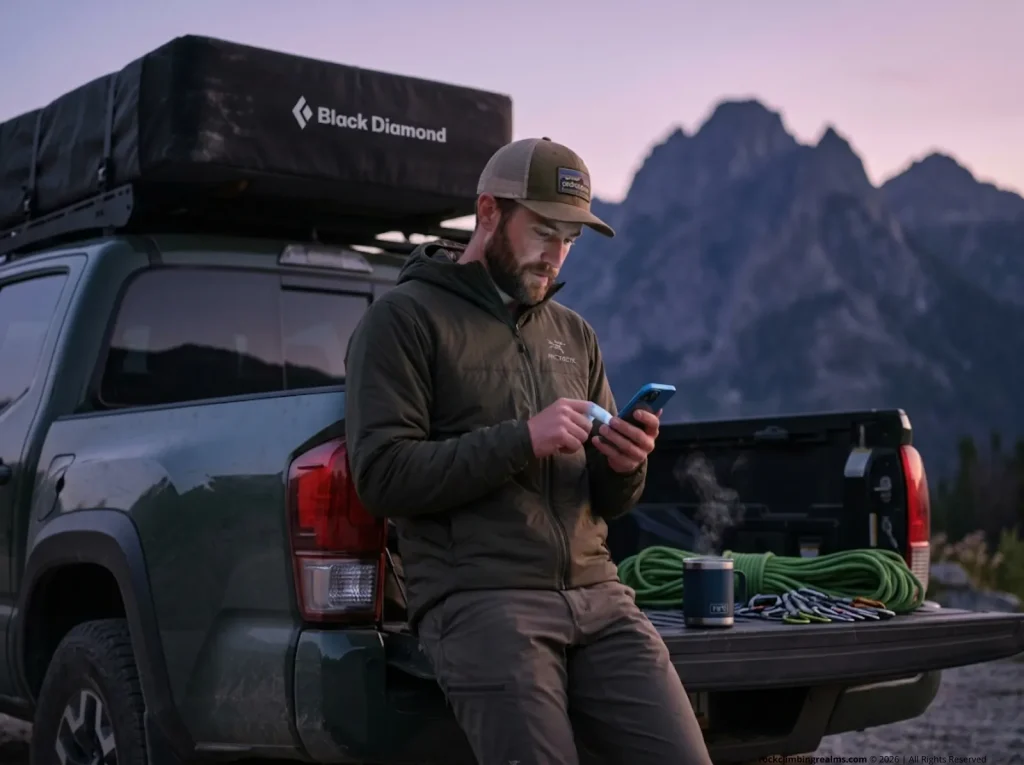
Wandering the forest looking for shiny bolts guarantees failure. Digital databases like Mountain Project, TheCrag, or 27 Crags are the primary methods to isolate high-probability areas for beginners. Avoid apps built for pebble wrestling like Kaya, which distract from finding secure rope routes. If you do not actively filter routes by grade and explicitly select “Sport” or “Top Rope,” you will find yourself standing beneath high-consequence trad climbing pitches that you possess zero gear to protect.
Target areas that are top rope accessible and strictly between the 5.0 and 5.8 difficulty ratings. Ensure the protection type consists of solid expansion bolts rather than aging traditional gear. Rely heavily on the star rating to dictate safety. Three and four-star routes are community “classics” that see massive foot traffic, naturally scrubbing the rock of loose rock that snaps off in your hands. You must combine these app searches with decoding route symbols and digital topos to isolate high-probability safe areas before leaving home.
Read the comments carefully when selecting a route name, specifically looking for hazardous attributes. Interpreting Mountain Project comments means watching for terms like polished, where the holds act like slippery glass, or run-out, which flags massive, hazardous gaps between bolts. You must qualify the belay platform quality right away because an outdoor route’s safety starts squarely in the dirt. If the belayer stands on a scree-filled slope, they will get dragged off their feet during a dynamic catch. Verify sun/shade orientation to prevent heat stroke, and confirm kid-friendly crags or dog-friendly crags if bringing your family to ensure flat staging zones. Assume you have zero cell service availability; download all offline maps via Gaia GPS before driving out.
Pro tip: If the first three comments on a digital route guide highlight that the pitch is “spicy for the grade,” walk away immediately. “Spicy” is climbing slang meaning you risk severe physical injury.
The Visual Translation: Matching 2D Topos to 3D Rock
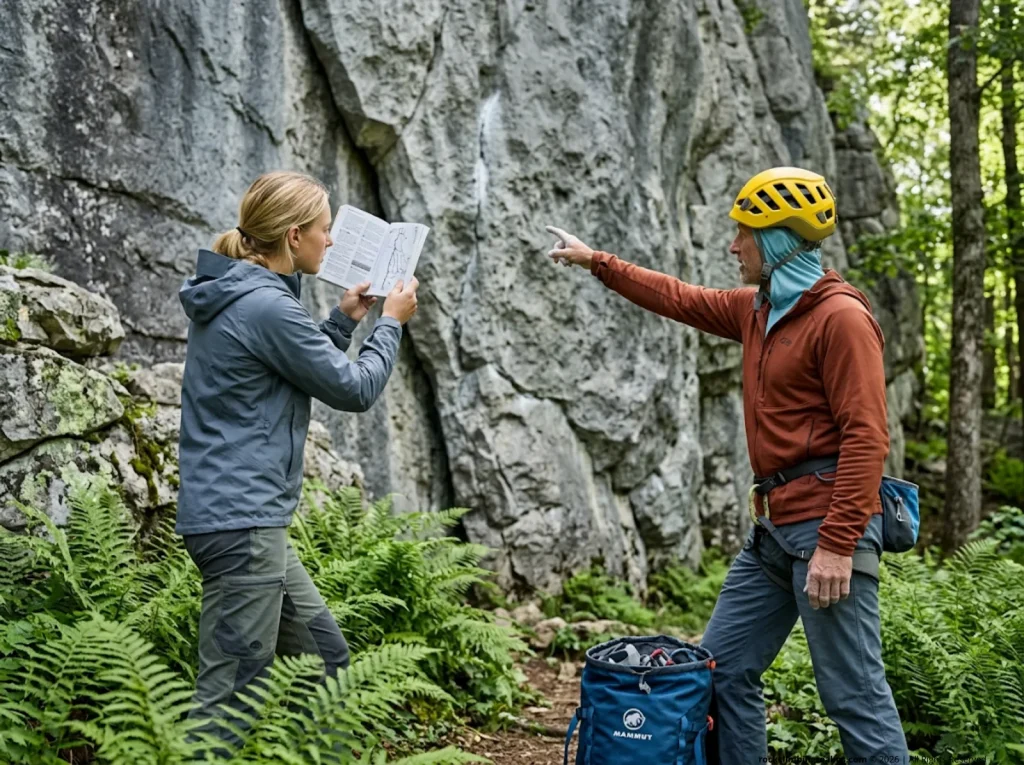
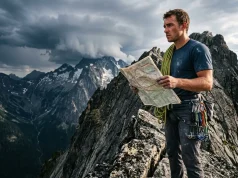
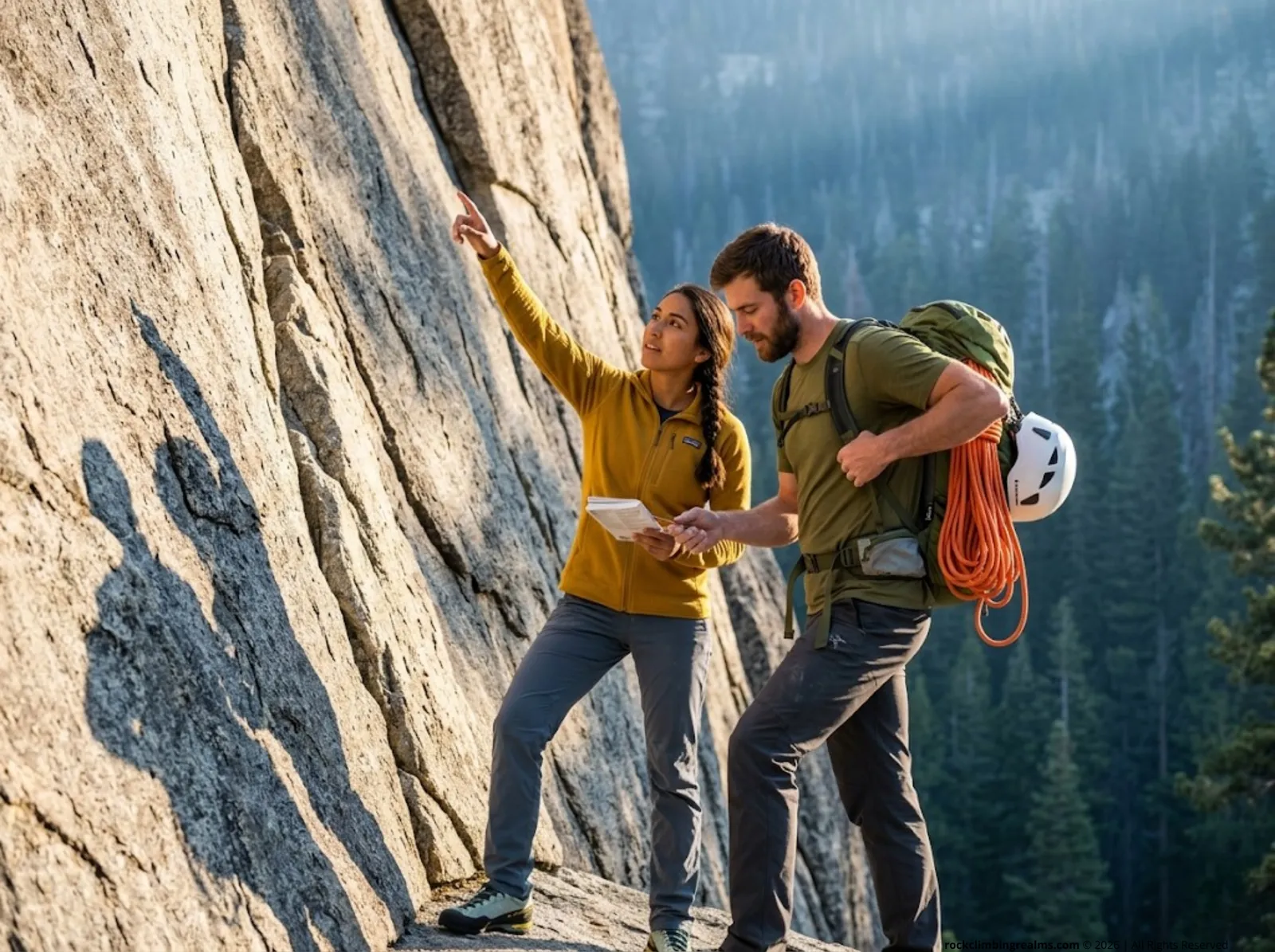
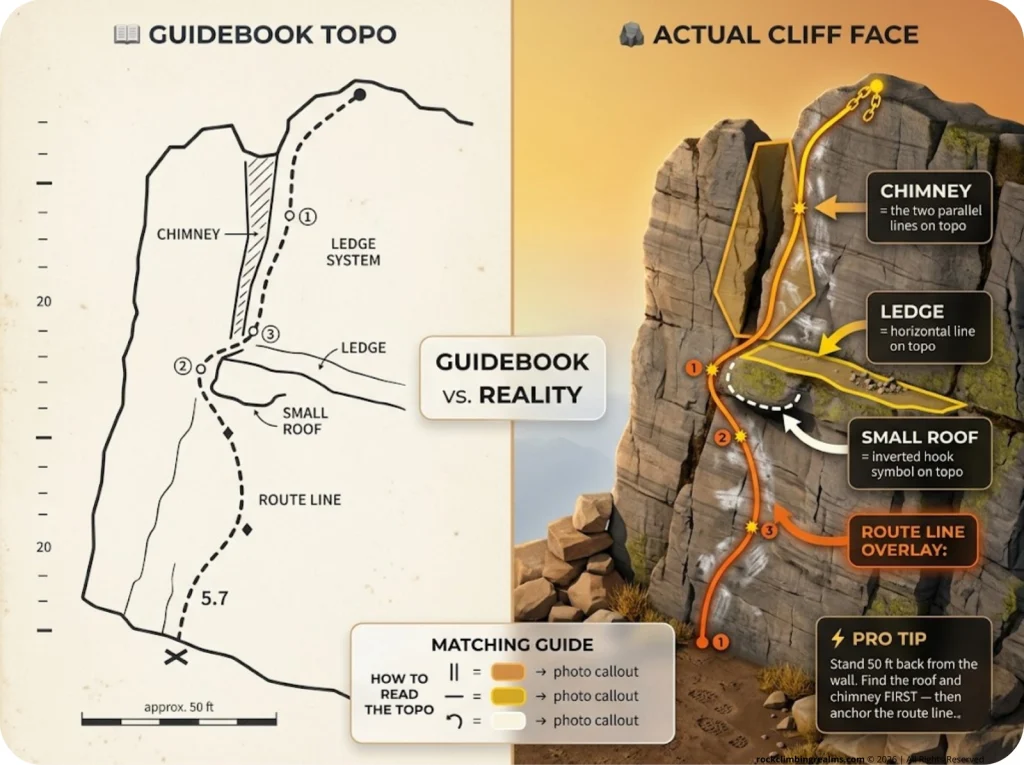
Navigating a complex approach hike to reach the general cliff coordinates with your crew is straightforward; finding the exact first bolt of your intended climb is the real challenge. Beginners face a severe visual translation gap because they cannot natively match the minimalist line drawing of a guidebook to the chaotic reality of a massive rock wall. You must master visual route matching from the ground before you put on your harness.
Never stand directly at the base with your neck craned backwards. Drop your pack fifty feet back from the wall to see the entire cliff band in full context. Identify the major features first, such as massive roofs, distinct dihedrals, or prominent trees on the ridge that the local guidebooks use to anchor their sketches. Once you isolate the general zone, search for small cues, specifically the white streaks of chalk and black shoe-rubber smears that indicate the main line of ascending traffic.
If you find yourself looking at a vertical face covered in green lichen without a single trace of chalk, you are almost certainly off route and scaling into loose rock. Rely on printed publishers like Falcon Guides or The Mountaineers Books for establishing your baseline, utilizing their printed high-resolution topos. You can begin reading a topo map properly and practice reading the sequence from the ground before leaving the dirt. Executing the task of matching topo photos to real rock serves as an operational safety skill that protects you from wandering off-route.
The “Anti-Sell” Gear Reality for Safe Cragging
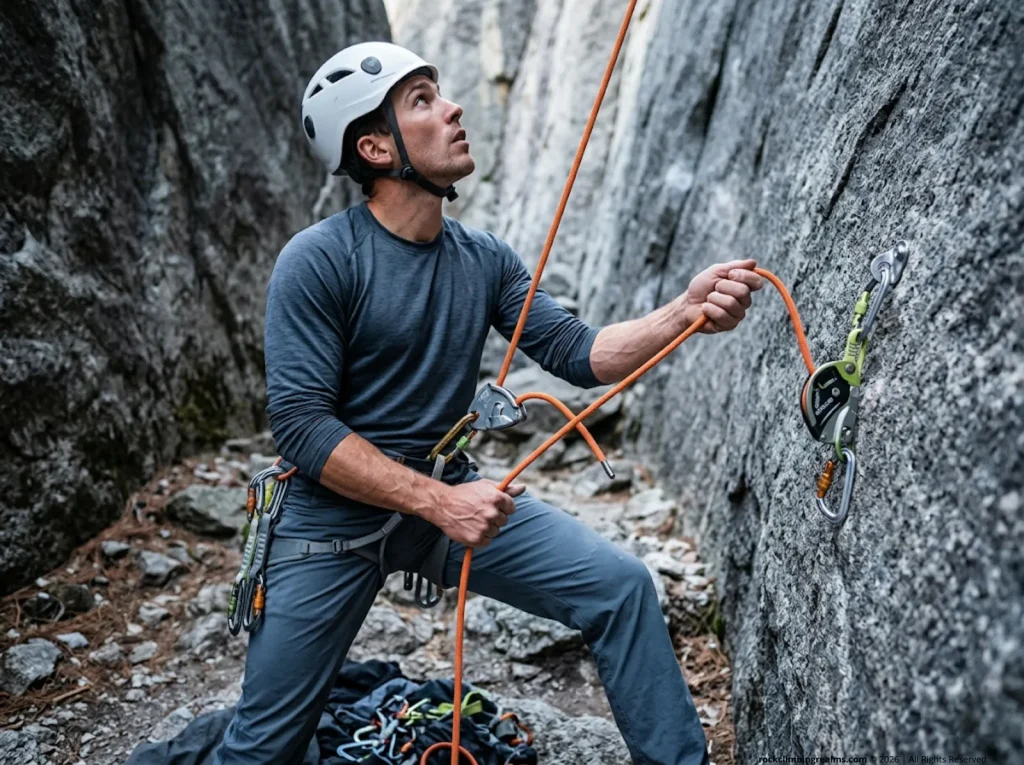
The indoor gym allows you to aggressively clip bolts in running shorts while renting gear. The outdoor crag demands specialized equipment explicitly manufactured and tested to save you from serious injury. You might shop at big box stores like REI for a synthetic jacket, but your safety systems require distinct, dedicated knowledge. We constantly see beginners upsold on ultra-light alpine gear that sacrifices durability, or attempting sport climbing wearing equipment meant for ascending snowy peaks.
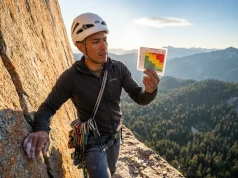
The absolute most critical structural piece is a certified hard-shell helmet. Gym climbers think helmets look foolish until a rock the size of a golf ball whizzes past their ear and craters into the soil. An outdoor helmet protects your skull from spontaneous rock descent and heavy carabiners dropped from parties multiple pitches above you. For harnesses, reject the ultra-lightweight models; as an outdoor novice, you need a wide, supportive padded waistbelt to handle the prolonged hanging belays and exhaustive route-finding pauses that occur outside.
Weight disparities are highly hazardous outdoors. Indoor floors have massive padding mechanisms to absorb momentum, but outdoors, a light belayer gets violently slammed into raw, abrasive granite and can lose control of the device. You must deploy an assisted braking device and rely on countering the rocket belayer effect with added friction if there is a massive weight gap. You must also understand the extreme dynamic forces acting on the anchor type holding your entire weight above you.
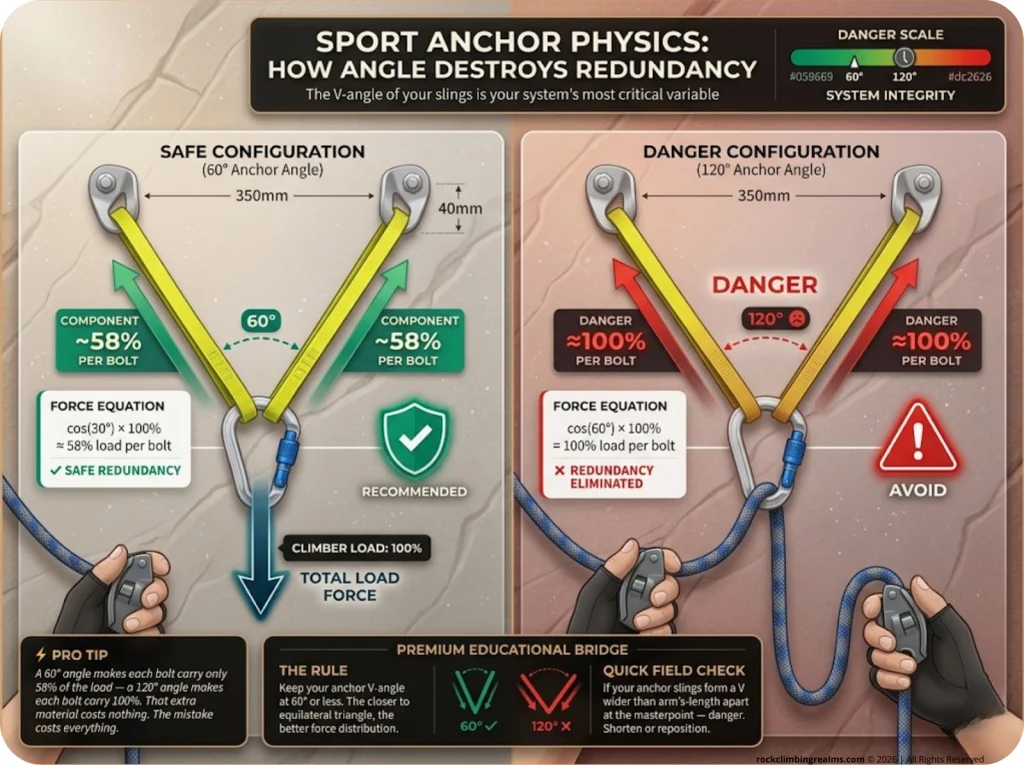
Outdoor anchors take massive force during a lead fall. Referencing the American Safe Climbing Association anchor guidelines, whether you are trusting a fixed anchor consisting of dual expansion bolts, or rigging a separate natural anchor holding a mature tree, physics dictate strict redundancy. Look at the angle of your connecting slings establishing the master point. A sixty-degree angle distributes force safely between pieces, but widening that angle towards one hundred and twenty degrees places maximum load directly on each individual component, totally destroying the system’s intended structural integrity.
Pro tip: A 60-meter rope represents the bare minimum length for standard cragging, but investing in a 70-meter rope prevents the fatal “lowering off the end” accidents heavily associated with modern pitch extensions. Always tie a secure stopper knot in the dead end of your rope.
Crag Stewardship and the Leave No Trace Imperative
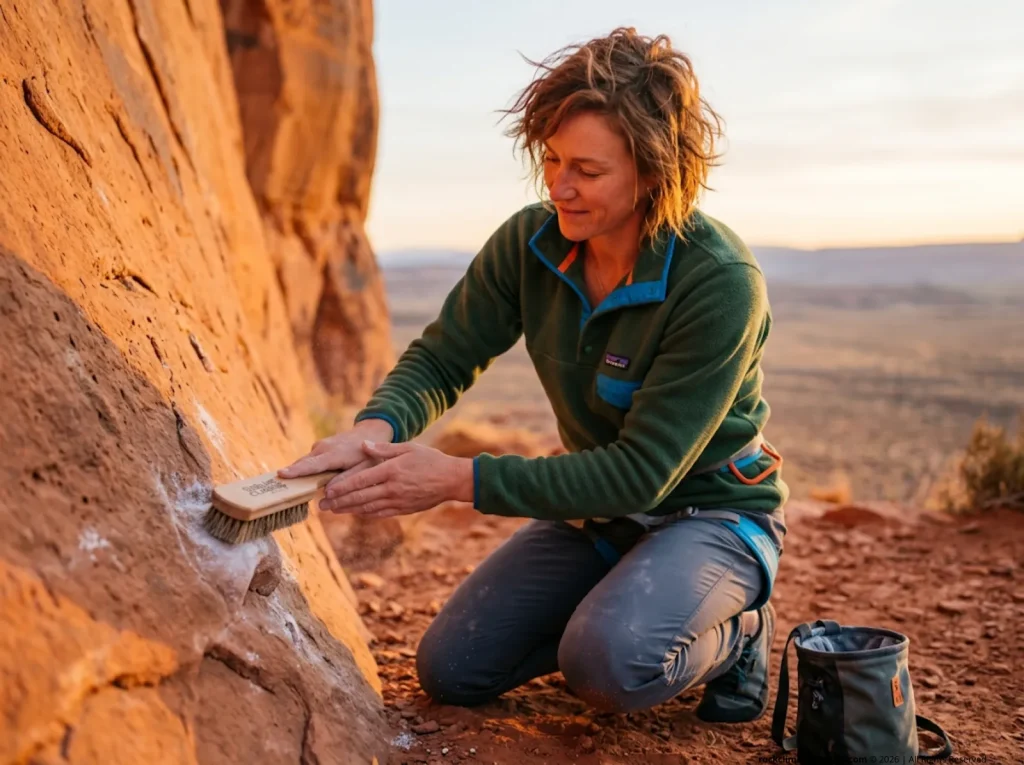
The immense surge in recreational climbing severely threatens global environmental access. As thousands hit the dirt at remote crags and popular spots alike, poor trail management, severe noise pollution, and trash accumulation have triggered total closures at legendary sectors. Practicing the leave no trace ethic remains the strict social contract required for outdoor survival. You must support local climbing access advocacy and adopt regional local ethics if you want to keep throwing your rope onto public lands.
Climbing on porous sandstone absolutely requires adherence to the three-day rule. Rain moisture massively weakens the internal structural bonds of sandstone walls. Pulling on a wet hold will rip it completely off the wall, permanently destroying the historic route and dumping you into an unprotected fall. Down in desert areas, wandering lazily off the designated approach time trails destroys the biological soil crusts. These living layers take centuries to grow and prevent mass land erosion, yet they shatter under a single errant boot print.
You must enforce aggressive sustainable practices during your descent. Never lower directly through fixed steel rings or chains resting at the summit because running sandy, loaded rope through metal acts precisely like a hacksaw over time. Instead, use two of your own quickdraws, set carefully opposite and opposed, on the top bolts to run repeated laps on the route. Ensure you are cleaning a sport anchor correctly before leaving, allowing only the very last person taking the route down to thread the fixed hardware. Following the American Alpine Club’s official climbing ethics ensures the cliffs remain open and respected for future generations.
If you are new to the sport, fully recognize that self-teaching critical rope skills is incredibly hazardous. Seek formal, regulated education from the American Mountain Guides Association (AMGA) or the ACMG. Asking strangers or posting on climbing gym bulletin boards is no substitute for hiring guides who will methodically teach you flawless anchor cleaning, redundant safety checks, and professional rappelling protocols.
Conclusion
Transitioning to outdoor climbing forces a massive shift from automated gym safety to rigorous, high-stakes self-reliance. Finding a safe route requires filtering digital databases aggressively to eliminate high-risk, sandbagged lines and focusing strictly on well-documented top-rope terrain. You must translate two-dimensional guidebook topos into physical rock face realities while managing severe hazards with heavily tested equipment systems. Next time you pack the car for a long crag day, grab your local guidebook, verify the approach beta, and meticulously scrutinize your anchors before your boots ever hit the dirt.
FAQ
How do I know if an outdoor route is truly beginner-friendly?
A genuinely beginner-friendly route should carry a moderate grade perfectly between 5.0 and 5.8, hold a verified Sport or Top Rope database designation, feature at least a 3-star community rating, and have recent comments proving the protective gear is solid rather than far apart. Look for flat, wide belay platforms and explicit mentions that the route is closely bolted to reduce initial falling distance. Always verify the overall area is not known for sandbagged, heavily stiff ratings before committing to the climb.
Is outdoor climbing harder than gym climbing?
Yes, outdoor climbing provides significantly more resistance and technical difficulty. Outdoor grades remain historically much stiffer because they completely lack brightly colored, obvious plastic holds, forcing you to constantly hunt for friction smears and visually scan the rock for usable edges. A 5.7 grade outdoors demands significantly more precise footwork, aggressive route-finding awareness, and psychological control than a 5.9 indoor plastic jug haul.
What is a sandbagged route?
A sandbagged climbing route is one that presents an extreme mechanical and physical difficulty drastically higher than its official numerical rating implies. Commonly found in older, historically significant climbing desert areas, these deceptive climbs require precise techniques and raw finger strength that will violently overpower a standard gym-trained beginner attempting their usual grade.
What gear do I need for my first outdoor climb that I don’t use in the gym?
You absolutely require a certified hard-shell climbing helmet to protect against rockfall and dropped metal carabiners from parties climbing above you. You also must carry an established personal anchor system (PAS) to safely secure yourself while cleaning routes at the top of the wall, and ideally, deploy a 70-meter dynamic rope to safely lower off the longer pitches heavily found at modern outdoor bolted crags.
Safety Notice: Rock climbing and mountaineering are inherently high-risk
activities that can involve physical trauma or fatal incidents. The information on Rock Climbing Realms is for
educational and informational purposes only. Techniques and advice presented here are not a substitute
for professional, hands-on instruction. Conditions and risks vary by location. Always seek guidance
from a qualified instructor before attempting new techniques. By using this website, you agree that you
are solely responsible for your own safety. Any reliance you place on this information is strictly
at your own risk, and you assume all liability for your actions. Rock Climbing Realms and its authors
will not be held liable for any harm, damage, or loss sustained in connection with the use of this information.
Affiliate Disclosure: We are a participant in the Amazon Services LLC Associates Program, an
affiliate advertising program designed to provide a means for us to earn advertising fees by advertising and linking
to Amazon.com. As an Amazon Associate, we earn from qualifying purchases. We are also an official affiliate partner
of Black Diamond Equipment via the AvantLink network. If you click on a Black Diamond affiliate link and make a
purchase, we may earn a commission at no additional cost to you. We also participate in other affiliate programs.
Additional terms are found in the terms of service.